


Meta Ads That Convert
Reach the right people at the right time with targeted Facebook & Instagram campaigns. We create scroll-stopping
ads, optimise performance, and turn attention into real leads and sales.
What we offer
Meta Ads
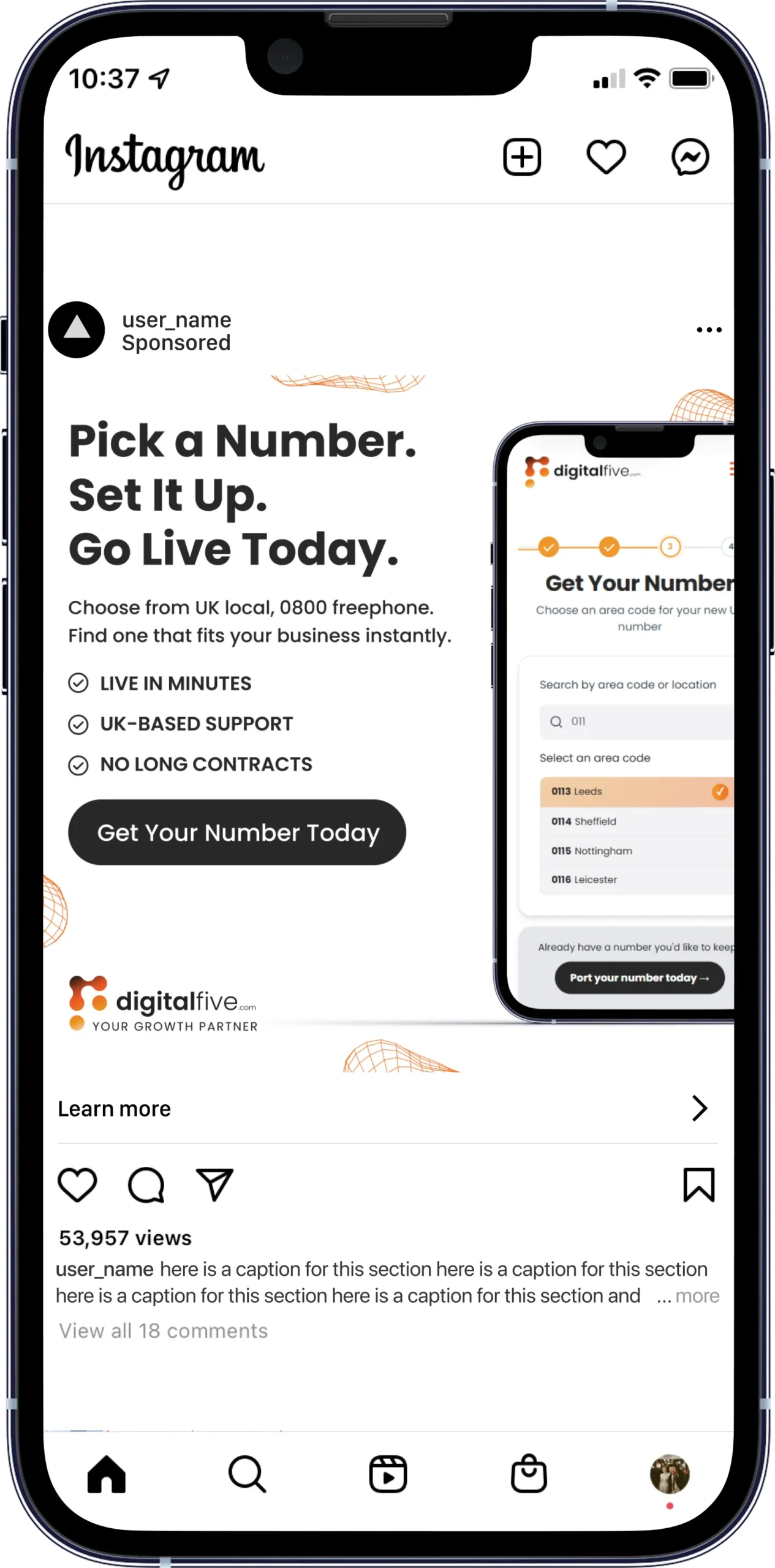
We don’t just run your ads — we manage your entire Meta strategy to deliver consistent, measurable results.
From precise audience targeting to ongoing optimisation, we turn attention into real leads and treat campaigns as a continuous partnership focused on growth.
Every campaign runs across Facebook and Instagram, with the Meta Pixel tracking exactly which ads bring in customers. You get plain-English reporting and a clear plan for what to test next, with no jargon and no guesswork.
The Three Tiers
Flat monthly retainers - no surprises, no percentage fees until you scale beyond £15k/month spend.
Starter
Recommended for ad budgets up to £2,000/month
per month · flat retainer
Facebook & Instagram ads
Both platforms managed together - one set of ads, two places they appear
One campaign goal
We focus on either new customers or retargeting - not both at once
2 ad tweaks per month
Wording, images, or headlines refreshed each month to keep ads from going stale
Monthly performance report
A plain-English email showing what worked and what didn't
Tracking setup
Meta Pixel installed so Facebook can see which ads actually got you customers
Quarterly strategy call
A call every 3 months to review progress, talk through what's working, and plan what to change next
Growth
Recommended for ad budgets £2,000–£10,000/month
per month · same fee regardless of spend
2 campaigns running together
Separate campaigns for new customers and for people who've already visited your site
Weekly tuning
Budgets, audiences, and bids adjusted every week to keep performance moving
2 new ads + 2 tweaks per month
Two fresh concepts plus two variations on what's already working
Monthly review call
A short call to walk through results, answer questions, and agree next steps
1 landing page update per month
We improve the page your ads point to so more visitors become customers
Quarterly strategy call
A call every 3 months to review progress, talk through what's working, and plan what to change next
Scale
Recommended for ad budgets £10,000+/month
per month · flat to £15k; 12% of spend above that
A named expert on your account
One specific person owns your account end-to-end - not a shared team
4 new ads + 8 tweaks per month
Enough fresh creative to keep ads from fatiguing and to test what's working
Fortnightly 30-min review call
Regular touchpoints to walk through results and agree next steps
CRM integration
Connect HubSpot, Salesforce, etc. to Meta so results are measured against real sales data
Monthly strategy call
A call with our senior strategist on direction and what to test next
Live performance dashboard
A custom dashboard you can log into any time to see exactly how your ads are performing
2 landing page updates + 1 new page per quarter
Ongoing CRO on existing pages, plus a brand-new page built every three months
Targeted & Personalised
Meta Ads
Our Meta Ads campaigns don’t just run broadly — we target each audience segment with precision. Using insights from behaviour, interests, and demographics, we make sure your ads reach the people most likely to engage with your business.
Combined with optimised landing pages, each ad feels relevant to the user, increasing engagement and conversions. This level of personalisation ensures your campaigns deliver measurable results every time.
Not Sure Where
To Start?
Book your free 15-minute call today and discover how we can bring your website vision to life.
Tell us what you’re looking for.
Let's Chat
FAQs
You will get better results if you treat it as a partnership. Provide:
- Fast access: Analytics, ad accounts, website, CRM, and any historic performance data.
- Product and customer insights: Common objections, best customers, margins and seasonality.
- Timely approvals: Creative and budget approvals keep campaigns moving.
- Sales follow-up: Quick, consistent follow-up improves lead-to-sale conversion and makes your marketing more effective.
Yes, many do. Content can include blogs, landing pages, guides, case studies, email sequences, and ad creative. The key is having a purpose, such as ranking for high-intent searches, supporting a sales conversation, or nurturing leads.
Yes, we can review your website. Once reviewed, our team produce an action plan which will drive you the best growth.
- Scope and Deliverables: Document what is included, what is excluded, and how changes are handled.
- Notice Period: Avoid long lock-ins unless there is a clear reason and value exchange.
- Data and Asset Ownership: You should retain ownership of ad accounts, analytics access, domains, pixels, and creative files.
- Reporting Cadence: Specify frequency and what is reported, including how success is defined.
- Handover: Ensure a clean exit plan, documentation, and admin access transfer.
Yes, and it is often most valuable in B2B because stakeholder needs can sprawl. Start with three meaningful segments, such as user, budget owner, and decision maker. Then build three benefits that map to each stakeholder’s definition of value. If the buying committee is larger, expand after you have validated the first three segments and benefits with data.
- PPC: Directional results often within 2 to 6 weeks, with stronger efficiency by months 2 to 3.
- Paid Social: Often 4 to 8 weeks to find early winners, then 2 to 4 months to stabilise and scale.
- SEO: Often 3 to 6 months for meaningful growth, longer in competitive spaces.
Early wins often come from measurement fixes, landing page improvements, and tighter targeting, rather than more spend.
Yes, especially because it reduces risk. Small businesses often benefit from protecting core channels while testing new ideas in a controlled way.
Yes, as long as you manage frequency and variation. Social feeds move fast, so repetition helps. Over-frequency can cause fatigue. Aim for a sequence of different creatives that repeat the same core message, supported by retargeting and clear next steps.
Often, yes. Some agencies handle both, while others partner with specialist developers. If the agency manages your website and SEO, confirm:
- Access and ownership: You retain admin access to your domain, CMS and Search Console.
- Technical standards: Performance, accessibility, and SEO foundations are addressed.
- Reporting: You receive clear reporting tied to traffic quality, rankings, and conversions.
Yes, we can. We build your site with SEO best practices and can support you with SEO, PPC, and social media to help you grow online.
It depends on your channel mix and starting point. Paid media can generate leads quickly, while SEO and brand building take longer. A well-run programme should show early indicators in the first 4 to 8 weeks, with stronger improvements over 2 to 6 months as learning compounds.
As often as you can without losing rigour. Many teams aim for a weekly or fortnightly cadence, but the right pace depends on traffic and risk. Consistency matters most: one well-run test per cycle beats five rushed tests you cannot trust.
When the tactic produces consistent results over time, fits your commercial goals and can be repeated at scale. A single good result is not enough. Look for reliable performance across multiple cycles.
Influencer marketing is typically a tactic within social media marketing, and it often sits under paid social. It can also overlap with content marketing because creators produce content assets. The cleanest way to categorise it is by the distribution channel, as most influencer campaigns run on social platforms.
Yes. The split should reflect your business stage, confidence in existing channels and appetite for growth. The framework is most useful when applied flexibly.
Use longer test windows, compare year on year where possible, and avoid running major tests during unusual spikes. Add guardrails such as lead quality or conversion value. Document context so you do not misread the outcome.
It can apply to both. Some teams use it for spend, while others use it for team time, content output, channels or campaign focus. The principle is the same: balanced allocation across confidence levels.
Ready to grow? Simply call us or fill out the form and our expert team takes it from there. We’ll jump on a quick discovery call to understand your business goals, then deliver a clear, tailored action plan with exact next steps and pricing — no obligation, no pressure.
Measure the goal most relevant to the test, such as click-through rate, conversion rate, cost per acquisition, lead quality or assisted revenue. The main aim is to learn whether the idea deserves more investment.
This is when your SEO and PPC strategies burst into life and the team continually refine the process to deliver the maximum growth.
The copywriting rule of three is a writing technique. It uses three phrases or items to make copy more rhythmic and memorable. The 3-3-3 rule is broader. It is a campaign planning framework that can include segmentation, benefits, touchpoints, creative, and distribution. They work well together: plan with 3-3-3 and write headlines using the rule of three.
No reputable agency can guarantee specific rankings, exact lead volumes, or a fixed ROAS. Outcomes depend on factors outside its control, such as competition, auction dynamics, seasonality, and your website and sales process.
What an agency can commit to is:
- Clear Deliverables: Agreed outputs and timelines.
- Transparency: Shared access to accounts and reporting.
- Governance: A testing plan, an optimisation cadence, and documented learnings.
There is no universal “7 days”. For impulse or promotional campaigns, 7 to 10 days can work. For considered services, 14 to 30 days is more realistic for an initial nurture cycle, and longer for complex B2B sales. The right time window is the one that matches your customers’ decision cycle.
We work with a wide range of businesses from startups, local service providers to established brands. Tailoring our approach to suit each industry and stage of growth.
People usually group them under search marketing because both target search behaviour. The difference is the payment model. SEO earns unpaid visibility over time, while PPC buys visibility straight away. In practice, they work best together. PPC provides quick data and leads, while SEO compounds.
Yes, as long as you choose metrics you can measure and you have enough volume. If you only get 10 conversions a month, you will struggle to detect a true 1% change. In that case, focus on bigger, higher-impact fixes first, such as offer clarity, tracking, or landing page fundamentals. Then move into smaller iterations as volume grows.
It is best described as a practical heuristic, not a single evidence-backed law. The underlying idea, that simpler choices and clearer messages reduce confusion, aligns with behavioural science concepts such as cognitive load and choice overload. Use it as a starting point, then validate with measurement. Test angles, monitor conversion behaviour, and keep what works.
Content marketing is the strategy and library of assets you build to educate and convert, such as guides, videos, and case studies. Social content is how you package and share ideas on social platforms. Social posts can support content marketing, but content marketing usually includes longer-lived assets on your website. These can rank in search and support email nurturing.
Case snapshot (anonymised): A common pattern we see is that combining SEO content with tightly targeted PPC reduces overall CPA over time. PPC captures high-intent demand immediately, while SEO and content expand coverage and improve landing page relevance. Email then converts more of the existing traffic by following up consistently. You can see the kind of outcomes this approach supports in the portfolio (https://digitalfive.com/portfolio/).
It depends. Some purchases happen after 1 to 2 high-intent touches, such as a search click to a strong landing page. Others take dozens of touches across multiple stakeholders. Use 7×7 as a starting point, then optimise based on conversion rate, cost per acquisition, and signs of fatigue.
